
Reflections on the hydrogen industry as we go into 2026
Robin Francis • December 22, 2025
The M-Spin team has attended, presented, and exhibited at a lot of industry events recently (a couple of photos are below). A lot, although not all, of these have been hydrogen focussed. So as we come to the end of a turbulent year, we thought it would be interesting to summarise some of the key themes we heard and give some of our perspectives on them. Opinions are my own!
Hydrogen – Some key themes and perspectives
In no particular order, here are some of the major themes we’ve been hearing:
- Signs of life in the market… – It’s no secret that it’s been a rough year for the hydrogen industry. Cancellations, push back on timelines & deployments, some high profile failures. But at recent events there was a general sense that 2025 is the bottom. Maybe there’s a bit of wishful thinking included, but it felt more grounded than that. Especially on the systems-integration side, people were pointing to a pick-up in actual orders, not just vibes from the ether. There was quiet confidence that from 2027/28 things would really pick-up steam.
- …but growing realism on use cases – We’re finally seeing some recognition that some hydrogen use cases may not make sense, and the industry should be focusing on the ones that do. And “About time” from my perspective! The whole binary “Hydrogen will solve everything” vs. “Hydrogen is useless” is not helpful IMHO. Some applications clearly just aren’t going to fly (e.g. passenger fuel cell vehicles), while others are almost no-brainers (replacing today’s grey hydrogen for chemicals production). In between there’s lots of complexity and dependencies.
- Focus on hydrogen as a feedstock, not a fuel – Hydrogen is just way more compelling as a feedstock than as a fuel. We’ve got plenty of fuel alternatives, and thermodynamics aren’t favourable for H₂-as-fuel. But as a reductant? Hydrogen is versatile, effective, and hard to beat in many applications.
- Innovation needed—everywhere – Production, transport, storage, end use. And we probably need more love for the “unsexy” stuff: pumps, compressors, power electronics. (I had no idea that even co-located renewables + electrolysers often still go DC→AC→DC, with all the pointless losses that implies!)
- Electrolysis still rules—but pyrolysis and gasification are in the mix – Tons of cool electrolyte tech happening, from fundamentals to making big kit work in the real world. But there’s also a healthy number of pyrolysis and gasification players around. Great in principle, but lots of difficult engineering challenges—variable feedstock, impurities, low efficiencies, etc. Still, the market is big enough for multiple winners. It’ll likely come down to “horses for courses”, but I would bet that electrolysis will always have by far the biggest slice.
- PEM and AEM are where the electrolysis buzz is – Conventional AWE is still around, of course, but most of the innovation and energy is going into PEM and AEM. Whether that’s due to strength or weakness on the part of the (mostly Western) players attending is probably a matter of perspective…
- The supply chain is still a mess – Fragmented, immature, and clearly one of the biggest challenges for the sector. This is exactly where government could really make a difference… but aside from generic “ecosystem building” talk, I didn’t see much in the way of real, concrete action to be honest.
- The sector can’t rely subsidies forever… – Support and regulation can give the sector a boost, but they can’t be the business model. We need applications that make sense on their own two legs. More springboard, less crutch.
- …but well targeted support can be really helpful… – Many people I spoke to mentioned the positive impact of the SAF (sustainable aviation fuels) mandate from the EU/UK. It’s a good example of how to create incentives for new technology development without being proscriptive – nobody is saying you have to use green hydrogen for SAFs, just that if you don’t come up with some way of doing it you’re going to get fined. This has parallels with the EU’s ever tightening rules for car emissions which successfully drove a big improvement in drive chain efficiency without specifying how you would do it technically. In our view this is one of the best ways of stimulating progress.
- Policy consistency is key – Yes, good policy, like the SAF initiative, is essential. But consistent policy matters even more. Constant chopping and changing—like the on-again, off-again enthusiasm for H₂ blending into natural gas—helps precisely no one.
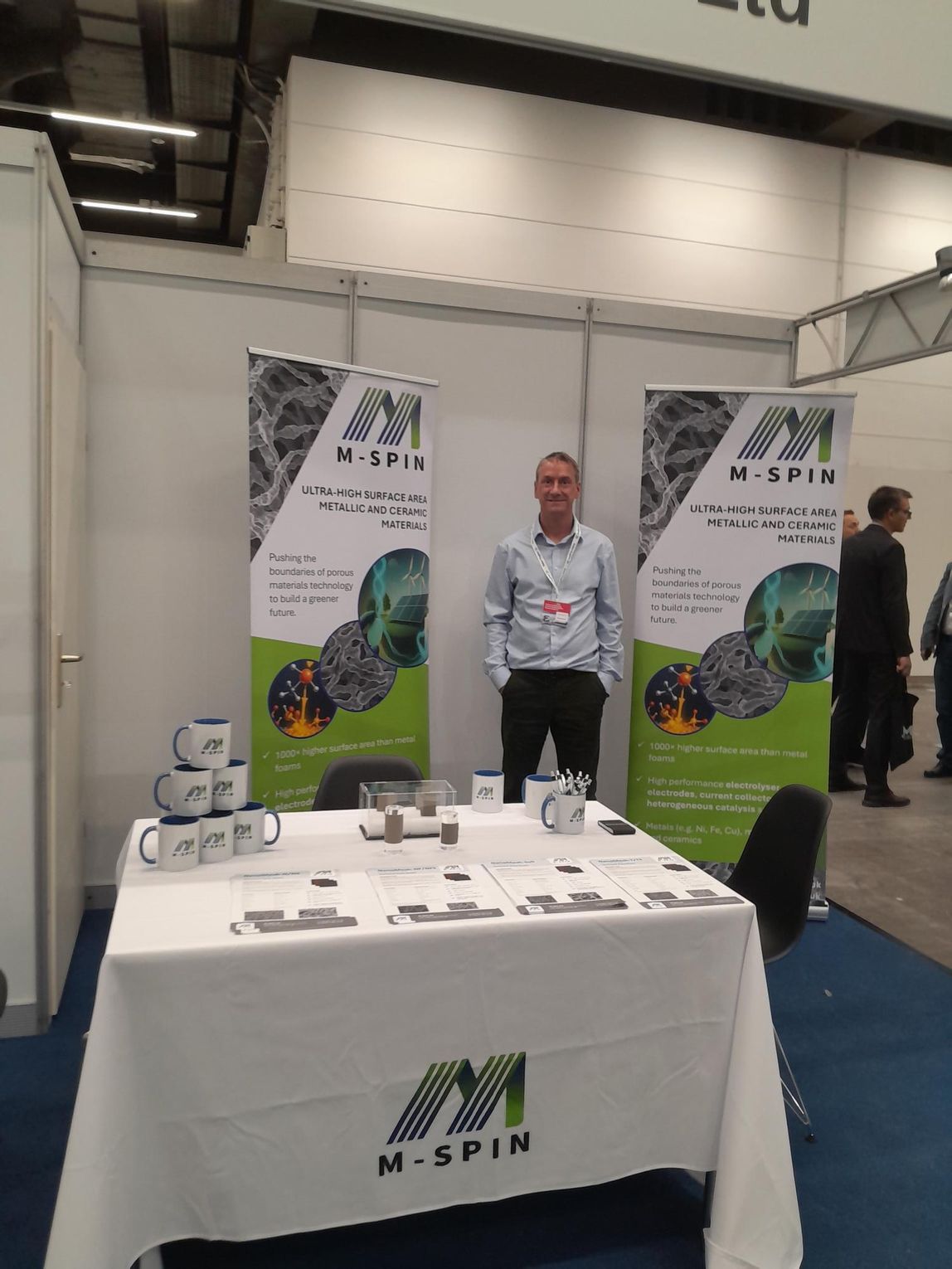
M-Spin’s stand at the Hamburg H2 Expo where we officially launched our “Nanomesh” range of ultra-high surface area metal products
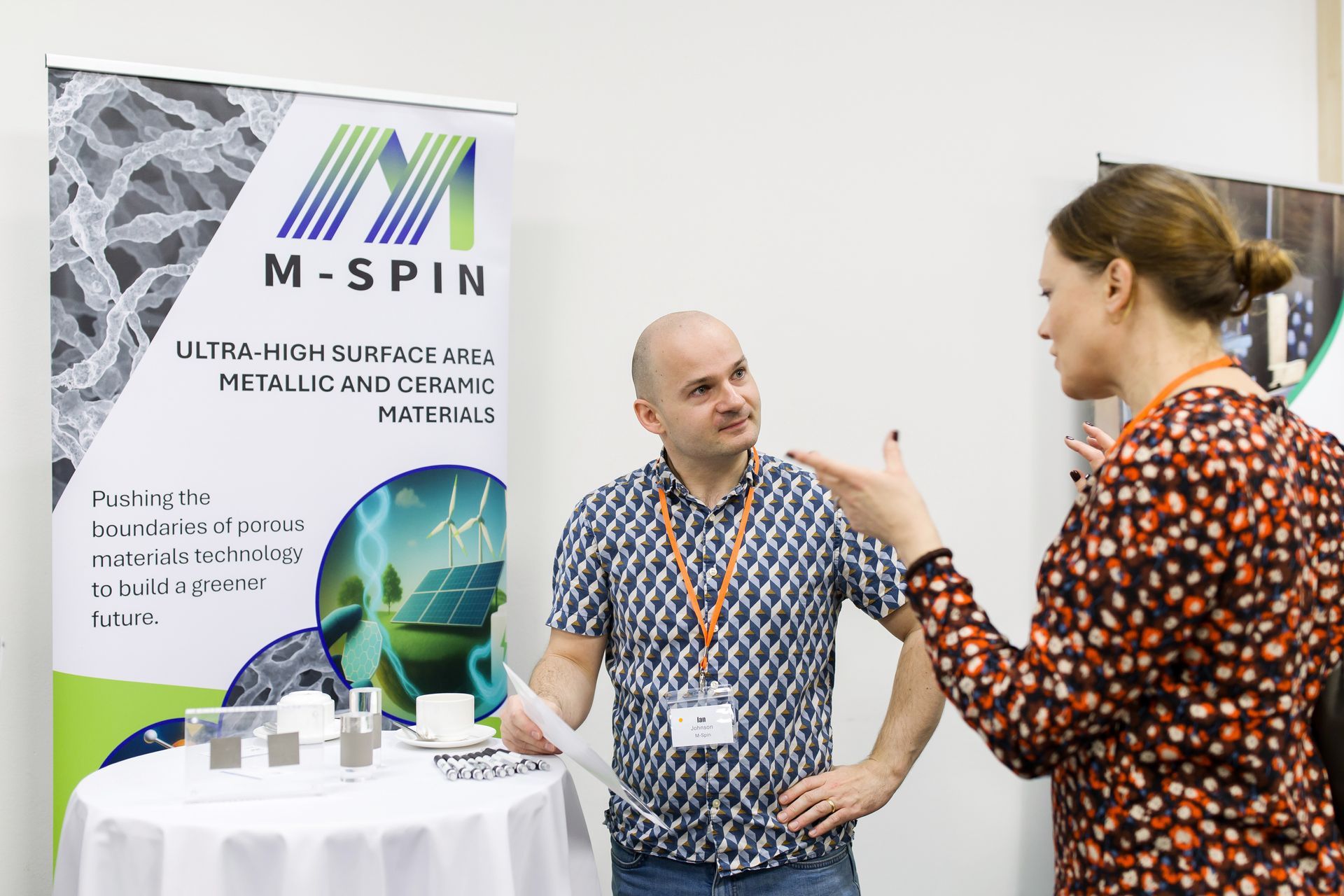
M-Spin Head of Product Development, Dr. Ian Johnson, explains the features of M-Spin’s technology at the Royce/HII Hydrogen Innovation Showcase
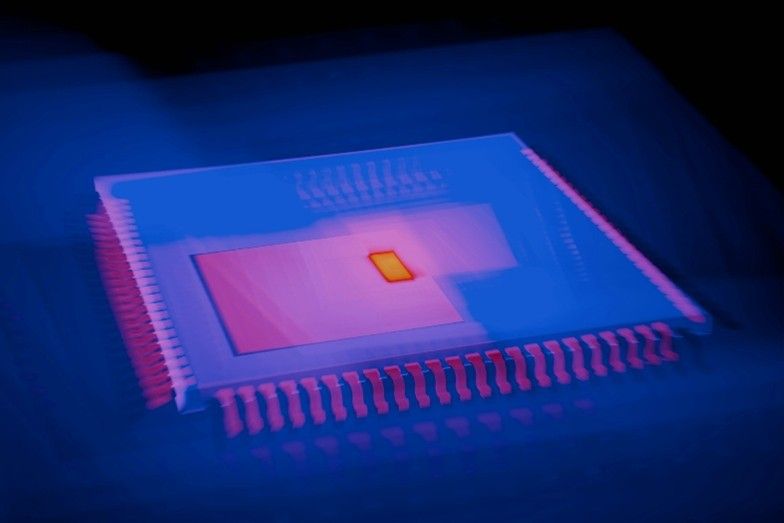
Lack of effective cooling is emerging as a key limiting factor for datacenters and the AI GPUs that run them. High powered GPUs generate a lot of heat, and getting rid of that heat is a major problem. Not only is cooling expensive – some 40% of the energy used in a data centre is for cooling – but ineffective cooling limits the power that chips can run at and reduces their lifetime significantly; not great when they are so expensive! This article explores possible solutions to this problem, and how M-Spin’s materials innovations can help. What limits what a datacenter can do? The obvious answer to this question is the raw power of the processing units (typically GPUs); in this case, however, the obvious answer is not the full story. In actuality, high-end processors have now become so powerful they are limited by not only how fast they can run but how hot they get while running. If running at 100%, high-end chips can easily exceed 150 °C, with severe consequences for their lifespan. In practice, output is throttled so that temperatures rise don’t rise above about 100 °C. Such protective measures can only do so much though, and consequently chip lifetimes in datacenters are very short (typically between 1 to 3 years). There’s a reason why high-performance gaming laptops recommend you buy a cooling pads to go with them – they enable the processor to run harder for longer.
At M-Spin we talk a lot about electrolysis and green hydrogen production - and indeed, this is one of our major focus markets. But electrolysis is far from the only use of M-Spin materials, with one particularly important application being batteries. This article explores how M-Spin materials can be used in batteries, which segments of the battery market are a particularly good fit for our materials, and how the properties of M-Spin materials can drive breakthrough performance in these segments. Batteries – The innovation opportunity From the early days of the portable electronics revolution in the 90’s, to more recent applications in electric vehicles (EVs) and grid storage, rechargeable technologies such as Li-ion batteries have become ubiquitous in modern life. This trend is only going to accelerate with the global shift to an electrified, decarbonised society – batteries are a crucial enabler for renewable energy generation, storing excess energy at peak generation and releasing energy at times of high demand. Indeed, the cost of solar power combined with energy storage is cheaper than coal and nuclear power generation in the sunniest parts of the world, with prices dropping >20% within the past year alone. [1] However, there continues to be a need to make batteries smaller, lighter and cheaper to make, to further accelerate their integration and adoption worldwide and improve the profit margins of cell manufacturers. It’s important to discuss the basic structure of a battery before we can understand how to improve them. Conventional batteries such as Li-ion batteries resemble a lasagne - built from multiple layers of anodes and cathodes (electrodes), which are adhered to current collectors (Cu for anodes and Al for cathodes). The anodes and cathodes are layered between separators (a porous polymer membrane ) and the entire stack is saturated with electrolyte – the “sauce” of the battery that allows lithium to flow through the cell. When the cell is charged or discharged, Li shuttles between the anodes and cathodes, either releasing or storing energy depending on the direction of the flow. The current collectors allow an electric current to flow into the anodes and cathodes. This battery structure can provide power, reversibly, over thousands of charge and discharge cycles. [1] https://ember-energy.org/app/uploads/2025/06/Ember-24-Hour-Solar-Electricity-June-2025-6.pdf

M-Spin produce metallic mats with >1000x the surface area of competing products. But, OK, so what? Why is surface area so important? Why do we make such a big deal about it? This article explores why surface area matters, how M-Spin creates materials with such a high surface area, and how this drives high performance. “God made the bulk; surfaces were invented by the devil” – Wolfgang Pauli Surfaces behave very differently to the inside (or “bulk”) of materials. In the bulk every atom of the material is surrounded (and bonded to) other atoms. However, at the surface the atoms are missing neighbours. Other atoms and molecules can take the place of the missing neighbours, binding to the surface, and undergoing reactions. Chemical reactions with solids always take place at surfaces.
